
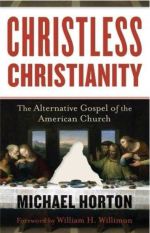
 Here we are in the North American church—conservative or liberal, evangelical or mainline, Protestant or Catholic, emergent or otherwise—cranking along just fine, thank you. So we’re busy downsizing, becoming culturally relevant, reaching out, drawing in, making disciples, managing the machinery, utilizing biblical principles, celebrating recovery, user-friendly, techno savvy, finding the purposeful life, practicing peace with justice, utilizing spiritual disciplines, growing in self-esteem, reinventing ourselves as effective ecclesiastical entrepreneurs, and, in general, feeling ever so much better about our achievements.
Notice anything missing in this pretty picture? Jesus Christ!
 “Indeed, all who desire to live a godly life in Christ Jesus will be persecuted.” – 2 Timothy 3:12
 “What Orwell feared were those who would ban books. What Huxley feared was that there would be no reason to ban a book, for there would be no one who wanted to read one. Orwell feared those who would deprive us of information. Huxley feared those who would give us so much that we would be reduced to passivity and egoism. Orwell feared that the truth would be concealed from us. Huxley feared the truth would be drowned in a sea of irrelevance. Orwell feared we would become a captive culture. Huxley feared we would become a trivial culture, preoccupied with some equivalent of the feelies, the orgy porgy, and the centrifugal bumblepuppy. As Huxley remarked in Brave New World Revisited, the civil libertarians and rationalists who are ever on the alert to oppose tyranny ‘failed to take into account man’s almost infinite appetite for distractions.’ In 1984, Orwell added, people are controlled by inflicting pain. In Brave New World, they are controlled by inflicting pleasure. In short, Orwell feared that what we hate will ruin us. Huxley feared that what we love will ruin us.”
 “Therefore remember that at one time you Gentiles … were … separated from Christ, alienated from the commonwealth of Israel and strangers to the covenants of promise, having no hope and without God in the world.” – Ephesians 2:11-12
 Something is starting to boil. It has been simmering for a while, kind of quietly on the back burner, but it seems the critiques have really escalated in the past few weeks and been brought to the forefront ever since Time Magazine published their
  This is a “prophetic” word from Calvin out of the Institutes related to the postmodern sensibilities of Western Christianity. I’m not implying Calvin was speaking directly against postmodernism itself as a formal philosophy, as it had not yet been articulated, but this certainly does speak against its core tenets asserted today, to be sure. And I would say that ultimately, postmodernism, within the setting of Christianity, leaves a person without certainty that they will be accepted before God, which is exactly what Calvin explains in this section. The reason for this is because if you have no certainty and a house built on solid rock, ultimately, you will try and pick up the slack of uncertainty through your own deeds, works and effort in order to please God, which oddly enough, is what we see happening with many (though not all) postmoderns in the focus of various ministry focal points (i.e. deeds versus creeds).