
Update: To her credit, Rachel Held Evans has come out and apologized for jumping the gun and assuming the worst about John Piper’s motives. I still maintain this brand of evangelicalism is on the Downgrade, but it’s good to see her admit a wrong committed and seek reconciliation (based on a number of tweets to that effect). http://rachelheldevans.com/blog/forgive-me
———————————————————————-
I fail to see how Rachel Held Evans theology (and others like her) escapes this assessment of liberal theology in the 19th and 20th centuries by H. Richard Niebuhr:
“A God without wrath brought men without sin into a Kingdom without judgment through the ministrations of a Christ without a Cross.” – H. Richard Niebuhr, The Kingdom of God in America.
The “universal acid” (Mohler) of skepticism and doubt eventually swallows up every doctrine of Scripture. Just ask Shelby Spong or Marcus Borg, they’ll tell you what they think. “Did God actually say ______?” (Gen. 3:1). This is the fundamental root of all sin, a doubting that God would actually speak clear truth in love toward us. What could be more loving than God giving us His words, preserved through centuries for our salvation? Maybe giving His own Son to suffer in our stead? Then again, penal substitutionary atonement is probably interpreted as “divine child abuse” (Chalke) to her. (Mohler)
For the postmodern, everything having to do with Scripture is vague or unclear and left to interpretation and therefore any interpretation is a go, or at the least entertainable, even though multiple ecumenical church councils over many centuries may have denied it, since that was merely their interpretation. But don’t worry, Rachel Held Evans and crew are here in their vast knowledge and research to rescue you from… Christianity, with its archaic, repressive doctrines and symbols that need a liberal, feminist, egalitarian, postmodern, 21st century makeover. James White is right to say that every generation must fight its own version of the Downgrade Controversy. This is ours and it’s here.
Interesting how the explanation of why Piper tweeted what he did and his response to what can only be described as cynical, hyper-emotional, unthinking criticism didn’t seem to make the presses though. But so goes Rachel Held Evans. Whatever fits the meme that Reformed people or conservative evangelicals in general are bad people, I guess. Smear the character, don’t actually engage the argument or the position. Sounds like far-leftist politics is invading the theological world. Eh, whatever gets blog hits right? Celebrity leftist evangelicalism at it’s finest, letting the Xian PR machine take over. Boy did this get her some traffic.
Also interesting to note is that Evans cites a sermon by open theist Greg Boyd after updating her blog post. Explains much. “Escaping the Twilight Zone God”
Evans represents a brand of evangelicalism that sits atop shaky ground; building a house on the sand. It’s been a long time coming and looks to be giving way. In my absolute frustration at what I read from her and other likeminded individuals is utter sadness. Once emergent theology started blending more with average evangelical churches, it was only a matter of time and tilt of the slope. Unfortunately it won’t end well.
Douglas Wilson gives Rachel Held Evans a well-deserved response for such sloppiness and avoiding the glaring problem that remains: http://dougwils.com/s16-theology/rachel-held-evans-denies-the-cat.html. Don’t miss it.
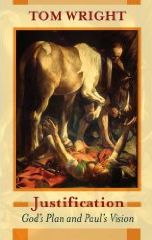 In speaking of N.T. Wright’s new book, Justification: God’s Plan and Paul’s Vision, responding to and critiquing Piper’s defense of justification, entitled, The Future of Justification, itself critiquing Wright’s understanding of justification, McLaren says, “John Piper, it turns out, has done us all a wonderful favor. In writing the critique that invited this response, he has given Bishop Wright the opportunity to clearly, directly, passionately and concisely summarize many of the key themes of his still-in-process yet already historic scholarly and pastoral project. Wright shows–convincingly–how the comprehensive view of Paul, Romans, justification, Jesus, and the Christian life and mission that he has helped articulate embraces ‘both the truths the Reformers were eager to set forth and also the truths which, in their eagerness, they sidelined.’ Eavesdropping on this conversation will help readers who are new to Wright get into the main themes of his work and the important conversation of which it is a part. And it will give Wright’s critics a clearer sense than ever of what they are rejecting when they cling to their cherished old wineskins of conventional thought.” —Brian McLaren, author A Generous Orthodoxy