
UPDATE: I’ve reconsidered some of the things I originally wrote in this entry and come to understand that Scripture itself, apart from people in general, speaks of both being saved “through” faith and “by” faith and meaning the same thing. The important distinction I wanted to make here was that faith itself a gift granted by God, not something we conjure up out of our dead, sinful hearts. We’re saved by God through faith, a faith that He gives. And at the same time, we’re saved by that faith, for without it, we’re lost.
 The distinction between these two ideas may seem like a minute point to contest in the world of theology. But each understanding has dramatic implications for how we view our justification before God. If on the one hand we view ourselves as being justified by faith, we will see it as the ground of our justification, where our doing and willing is what saves us. From talking to many believers, it seems this is how many of us view our justification or standing before God. Yet if on the other hand we view ourselves as having been justified through faith, then we see that our justification itself, and the faith required to obtain it, all rests on Christ’s work alone.
Now of course, many people simply say we are saved by faith and the mean the same thing as through faith. I’m not here to contest that. I’m speaking here of the theological difference of these two words, because each changes our perspective on it once pondered, I believe.
If our faith is the ground of our justification, then we can often wonder if we’re believing correctly or coming to Christ in the right way (which I have often had to dismantle as a concept for a few friends who doubted they had actually believed). But if we see that our justification is rooted purely upon the work of Christ to justify us by the power of His blood alone, then we see that faith is God’s instrument to bring us to Himself; that is to say that faith is a gift of God, not something we work up from within our sinful, unregenerate human nature. Regeneration precedes faith, or the new birth of the Holy Spirit spoken of in John 3 causes, or comes before, or immediately gives rise to faith, not vice-versa.
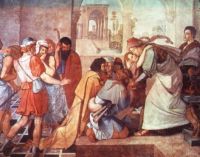 “When Joseph’s brothers saw that their father was dead, they said, ‘It may be that Joseph will hate us and pay us back for all the evil that we did to him.’ So they sent a message to Joseph, saying, ‘Your father gave this command before he died, “Say to Joseph, Please forgive the transgression of your brothers and their sin, because they did evil to you.” And now, please forgive the transgression of the servants of the God of your father.’ Joseph wept when they spoke to him. His brothers also came and fell down before him and said, ‘Behold, we are your servants.’ But Joseph said to them, ‘Do not fear, for am I in the place of God? As for you, you meant evil against me, but God meant it for good, to bring it about that many people
 Today, Scot McKnight
Matthew Henry on Jesus’ Prayer Life
By David Westerfield
On January 21, 2009
In Scripture, Theology
I thought this was a timely quote from Matthew Henry’s commentary on the Gospel of Matthew, since our church is going through a study on prayer in the believer’s life. I pray this encourages you to seek private communion with the Lord. In our fast-paced, entertainment-driven, constantly distracted culture, it is very easy to neglect this practice, because there is always something else you could be doing. But it is necessary for the joy of our souls to be daily absorbed in God’s presence by His Holy Spirit, made possible by the cross of Christ. This is taken from here at CCEL.org.
He went up into a mountain apart to pray (Matthew 14:23). Observe here,
1. That he was alone; he went apart into a solitary place, and was there all alone. Though he had so much work to do with others, yet he chose sometimes to be alone, to set us an example. Those are not Christ’s followers that do not care for being alone; that cannot enjoy themselves in solitude, when they have none else to converse with, none else to enjoy, but God and their own hearts.
Read More