
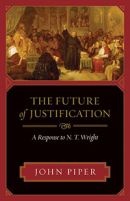
 In the past, just doing a cursory reading of some of N.T. Wright’s statements on justification, I thought that I could at least grasp a basic concept of his understanding of this centrally important piece of the Gospel message. Then I picked up Piper’s book. Now I’m even more confused than I was before; I now have some clarity on various points, but I see now I haven’t even scratched the surface of where the man is coming from on justification. Wright’s comprehensive picture of God’s working out salvation in history seems to be coming from a totally different avenue, one the church has never been down in 2000 years. It seems Piper is confused at points to, or sees seemingly contradictory understandings within Wright that he is putting out there at various junctures. While reading Piper’s critique and seeing quotes of Wright’s, I think to myself, “This is a Catholic understanding of justification,” and then at other points, I affirm with Wright that part of his articulation is the traditionally historic Protestant view (i.e. the “Wright” one … get it? Wow, okay I’ll stop … you knew it had to come, ya know, a pun … okay I’m digging a hole).
Things became much clearer tonight though as I continued reading (as much as it can in waters already muddied by a whole new articulation of a super vital doctrine that has never once appeared in all of church history). One of the things that has really come to bear in my understanding of Wright on justification is the way in which he distinguishes present and future justification. I have never even considered these as two separate, yet related doctrines (nor do I at this point still, just so I’m clear … I believe I’m justified now and will be in the future on the same basis, Christ alone). In the present, says Wright, we are justified by faith alone, knowing that all Christ has overcome and achieved is ours, or in other words, the verdict is in: we are His and have been made His by Christ. Okay that’s comforting. Here it comes though … yet future justification, the justification yet to occur at the judgment seat of God, is faith and the entire life lived in love as a confirmation of true, authentic saving faith. Confused?
With Piper, along with Wright, I concur that our lives should be overflowing with good works (imperfectly) from the supposed supernatural change in our hearts we claim to have had happen in us by God’s working alone, and that if that isn’t happening in us now (or we have no desire or struggle even with such things), we should very well question if God has born us anew at all; that is, is our faith the work of God in us alone to save us and keep us, or is it a false faith we worked up out of our sinful flesh that cannot stand the test of time and trials that will inevitably come (and believe me, they will)? If God has created in us a new heart, made us a new creation by the resurrection of Christ, then what necessarily results from that supernatural work in us is sweetness and fruitfulness, not bitterness and rottenness. I affirm this with Piper and Wright.
Wright is correct to point out that so much of Protestantism has erred in not presenting a balanced view of Paul’s understanding of faith and works, that the two go hand in hand. You cannot have one without the other (James 2:14-26). If God brings about faith in your heart, faith that can only come from Him, a faith that is supernaturally struck by the “beauty of His majesty” and the extent to which He went to bring us to Himself, that faith will inevitably produce good fruit because that is what we’ve been redeemed to. Faith and works are indeed interconnected.
But are they interconnected as the basis for our final justification? Or even our present justification? And yet somehow that understanding in itself isn’t connected with my present justification before God’s throne (the very thing that gives me hope when I’ve sinned and fallen short of the glory of God)? Are the two “justification’s” even distinguishable other than by time? I have a hard time accepting that understanding. It’s like a synthesized version of Protestant and Catholic views on justification almost, patching the former into our present justification and the latter into our future justification. Ultimately though, it comes down to our works in his view, from my standpoint.
I affirm with Piper that in Wright’s view of these two “justification’s” (present and future), the basis or root of both is different. In the present, for Wright, justification is rooted in faith alone through Christ alone. Yet in the future, our justification, the final proclamation of our vindication, that we are God’s covenant people, is based on our faith and our whole life lived … or in essence, our works. I agree that faith “works in love” of necessity and the effect of faith is works, but negate the understanding that our justification, either present or future, rests on faith + works in any fashion. This itself is a perversion of the Gospel of Christ and, as Martin Luther said, sola fide (faith alone) was “the very hinge upon which the Reformation turned.”
I have a hard time accepting the idea that my present justification and my future justification are somehow not the same at the root, that is in Christ’s work alone, appropriated through faith alone, that is all granted by God’s grace alone. The thing that gives me hope, everyday, is that both forms of justification, present and future, are exactly the same and are both rooted in the singular saving work of Christ alone, wrought out upon the cross, sealed and confirmed in the resurrection, and applied by His Holy Spirit to His elect covenant people, and in my particular case. It is knowing I’m secured by His grace, that I’m declared righteous, that gives me freedom to work for His glory and honor, because now no longer am I doing it to be justified (or made right with God), but I do it because I want to out of a love that overflows in my heart (all of which is it self a gift a grace).
If in the present I look off into the future justification of my life at the judgment seat of Christ and I see that His judgment of me is based on my faith and the life I’ve lived (or works), and not merely faith alone, will I not attempt to work harder to make sure “I’m in” the covenant community of God? Does my final justification then not hone in and rest upon what I’ve done in my life, which is defiled and wretched? What hope is that?
You see then, in all reality, if I believed this, ultimately the final verdict of whether or not I go to heaven or hell depends on my obedience, my works, which once again hits at the very distinguishing mark between Protestants and Catholics for 500 years (which Wright, in my opinion is folding on doctrinally): for Catholics, their justification, or right standing before God, comes by faith and works, produced by the infusion of the Holy Spirit into their hearts; for Protestants, our justification is through faith alone, that we are accounted righteous by Christ’s working on our behalf … but we saved through a faith that works in love of necessity … because the faith that God grants His people is of Himself and full of power, effectively changing the course of our entire lives (though we still yet remain imperfect). Ephesians 2:8-10 articulates this Protestant doctrine the best: “For by grace you have been saved through faith. And this is not your own doing; it is the gift of God, not a result of works, so that no one may boast. For we are his workmanship, created in Christ Jesus for good works, which God prepared beforehand, that we should walk in them.” God saves His people by grace, granting faith, which justifies them, and then He moves in them to work for His glory.
I find all of this highly confusing, especially to those who have only a fundamental understanding of what justification is, let alone Wright coming along and making distinguishing marks between two different kinds, a present and a future justification. Wright says the Reformers were confused on the issue and that the conversation between Protestants and Catholics got off on the wrong foot during the Reformation. But I can only say Wright seems to have confused himself 1) about what the Reformers were saying concerning faith and works, and 2) he may be reading too much Second Temple Judaism back into the texts of Romans and Galatians in particular.
But, I am no scholar, nor do I presume to be, nor have I read any Second Temple Judaism from which to make any kind of a standing assertion such as that. I have only grasped a few of the concepts Wright is articulating, or at the very least attempting to, so I could very well be wrong and misunderstanding what he is saying. As you study, one of the things you realize is just how little you know of anything really. If Piper is confused at points, surely I’m going to be. Somehow I feel that Piper’s confusion comes from (possible) contradictory statements and a (possibly) confused N.T. Wright who is uttering them. But maybe I have a bias.
 “For thus says the Lord God: Behold, I, I myself will search for my sheep and will seek them out. As a shepherd seeks out his flock when he is among his sheep that have been scattered, so will I seek out my sheep, and I will rescue them from all places where they have been scattered on a day of clouds and thick darkness. And I will bring them out from the peoples and gather them from the countries, and will bring them into their own land.” –
  “For whoever keeps the whole Law but fails in one point has become accountable for all of it. For he who said, ‘Do not commit adultery,’ also said, ‘Do not murder.’ If you do not commit adultery but do murder, you have become a transgressor of the Law.” –
  “But we are drunk with the false opinion of our own insight and are thus extremely reluctant to admit that it is utterly blind and stupid in divine matters. Hence, it will be more effective, I believe, to prove this fact by Scriptural testimonies than by reasons. John very beautifully teaches it in a passage that I have previously quoted; he writes that: “Life was in God from the beginning and that life was the light of men; this light shines in the darkness, but the darkness comprehends it not” [
 A friend of mine posted this link under an item I posted recently on Facebook and so I thought it was pertinent to read in itself. It seems secular marketers have moved more and more into the Christian publishing market, and as a result, we are receiving what we “want” to read based on statistical analysis, not necessarily what we need to be reading as believers. We need to take it back for the glory of God, not the glory of profit.
Lord, Have Your Way in Me
By David Westerfield
On November 12, 2008
In Christian Culture, Music, Theology
When we ask the Lord to have His way in us, it may be that He sovereignly decides to allow that which happened to Job to happen to us, or at least something comparable. Youch. Are we preparing now spiritually for this, before it happens, through Scripture studying, prayer, communion with God, and fellowship with other believers, which should all spill over into the unbelieving world around us through love and good works? And trust me, at some point trials will come, if they haven’t already.
The lyrics right before this line, at least to me, can tend to soften this implication when they say, “Every breath that I take, every moment I’m awake … Have your way in me.” In no way am I criticizing the intention of the artist, Reuben Morgan, for I believe the intention in this lyric is good, and is a decent literary way of displaying our relationship with Christ. But it’s just so nice and fluffy to sing about the air we breathe, the moment by moment nature of our relationship with God in Christ and what we’re going to do for Him (you know, the whole WWJD/WHJD distinction – “What Would Jesus Do?” versus “What Has Jesus Done?” as a motivator for holiness?). Yet that last phrase in the chorus has vast implications in our lives. And these implications are thoroughly talked about in Scripture.
Here are just a couple of examples amongst many (including the whole book of Job):
“More than that, we rejoice in our sufferings, knowing that suffering produces endurance, and endurance produces character, and character produces hope, and hope does not put us to shame, because God’s love has been poured into our hearts through the Holy Spirit who has been given to us.” – Romans 5:3-5
In contradistinction to an understanding I recently read on a forum pertaining to this verse, in no way do I believe this is talking about the mundane, day to day, light-weight trials we pampered Americans go through on a daily basis, like work, traffic, school, etc. Please.
We American Christians are in the minority of total Christians in the rest of the world. And a majority of the rest of these Christians are being persecuted in ways we cannot even dream of in America. There is pure hatred for the people of God in the world and I do believe there is a time coming when it will be here as well. I highly doubt those persecuted Christians, as well as the history of the whole church’s understanding of this text, would come to this same, “three inch deep” conclusion.
It’s so easy to read a text of Scripture through the filter of our own experience, our own cultural point of view and our own socio-economic vantage point. This text is talking about Trials with a capital T, because Paul’s audience was a group of believers who were experiencing exile, imprisonment, beatings, torture, death, and financial distress of a kind we have not even seen in our life time, let alone in America. It can definitely mean trials such as family-related issues, natural disasters, all kinds of other things that we do experience here in America. But in context, Paul had a specific intention to his readers.
And not only this, but it says to rejoice in those very sufferings! Rejoice! How? Only by God’s Spirit working in us is this possible. We need Him desperately to supernaturally work this kind of divine affection and love into us, for it is foreign to our sinful natures and our flesh. When we consider that as the people of God we are like gold that is refined through fire, it is only in this mindset and perspective that we can rejoice in trials, for they are God’s work in us to make us like Himself.
“Count it all joy, my brothers, when you meet trials of various kinds, for you know that the testing of your faith produces steadfastness.” – James 1:2-3
The result of these trials and the reason we should rejoice in that which the Lord has sovereignly ordained for our lives, is that in them, the Lord produces in us steadfastness. And as those verses in Romans say above, in sequential order, we know “that suffering produces endurance, and endurance produces character, and character produces hope, and hope does not put us to shame, because God’s love has been poured into our hearts through the Holy Spirit who has been given to us.”
“Because God’s love has been poured into our hearts through the Holy Spirit who has been given to us.” The reason we can rejoice is that in the trials God mercifully brings (being that they are making us into the image of Christ) we see God’s faithfulness to sustain and stoke our faith (in the same way you stoke fire with more wood and blowing air into it) when everything else gives way around us. And this in itself is confirmation that we are chosen of God, elect, the predestined people of the Lord, whom He has unconditionally set His loving favor and affection upon, made effective through the cross of Christ, sealed in His resurrection.
We can be assured of our salvation and His choosing of us for it when trials come and we continue trusting in and holding onto God’s promises in the midst of them, for this itself is the working of God in us and the visible evidence of our conversion, started by God in our spiritual birth, who will then bring it to completion at the Day of Jesus Christ (Philippians 1:6). And in this we greatly rejoice, for our final hope and the ultimate goal of all this is sharing in the glory of God forever with all of His people!
My whole point in all of this is that the words we sing to the Lord carry weight and should not be taken lightly. And many times, I fear they are in many evangelical congregations. Sometimes the words carry more weight than we’re willing to admit and it is so easy to glibly gloss over their real meaning. This line is just one example.
If we really ponder the sustaining power the Lord has over our lives, for both blessings and trials, I believe we would fear the Lord properly, not a fear that shrinks away from Him, but that reveres Him for His awesome sovereign might and find peace and solace in His grace alone that sustains us in the midst of blessings as well as trials.
It is perfectly within His power to lift His hand and allow us to undergo suffering of all kinds and I believe we need to keep this in mind when singing these kinds of songs in particular. It should humble us and make us stop to think about what we’re really asking of the Lord.